
Rising costs, wrong solution: WorkSafeBC's new regulation adds to a problem it won't solve
Highlights
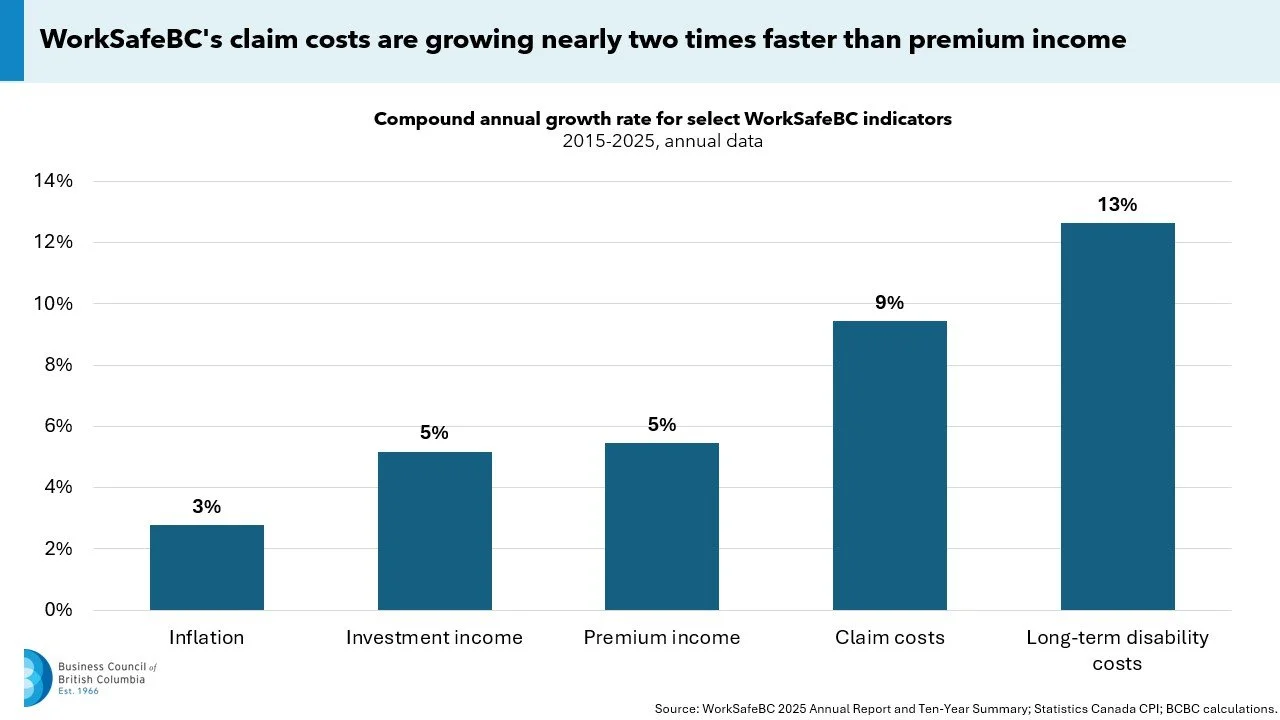
Between 2015 and 2025, WorkSafeBC's claim costs grew about 9 per cent per year while the premium income that funds the system grew about 5 per cent per year, nearly twice as fast.
Two forces are driving most of the cost increase: Bill 41, which in 2022 tied roughly $9.8 billion of WorkSafe's claim liabilities to inflation, and claims lasting longer and getting more complex. Notably, injury rates, adjusted for workforce population, have actually fallen.
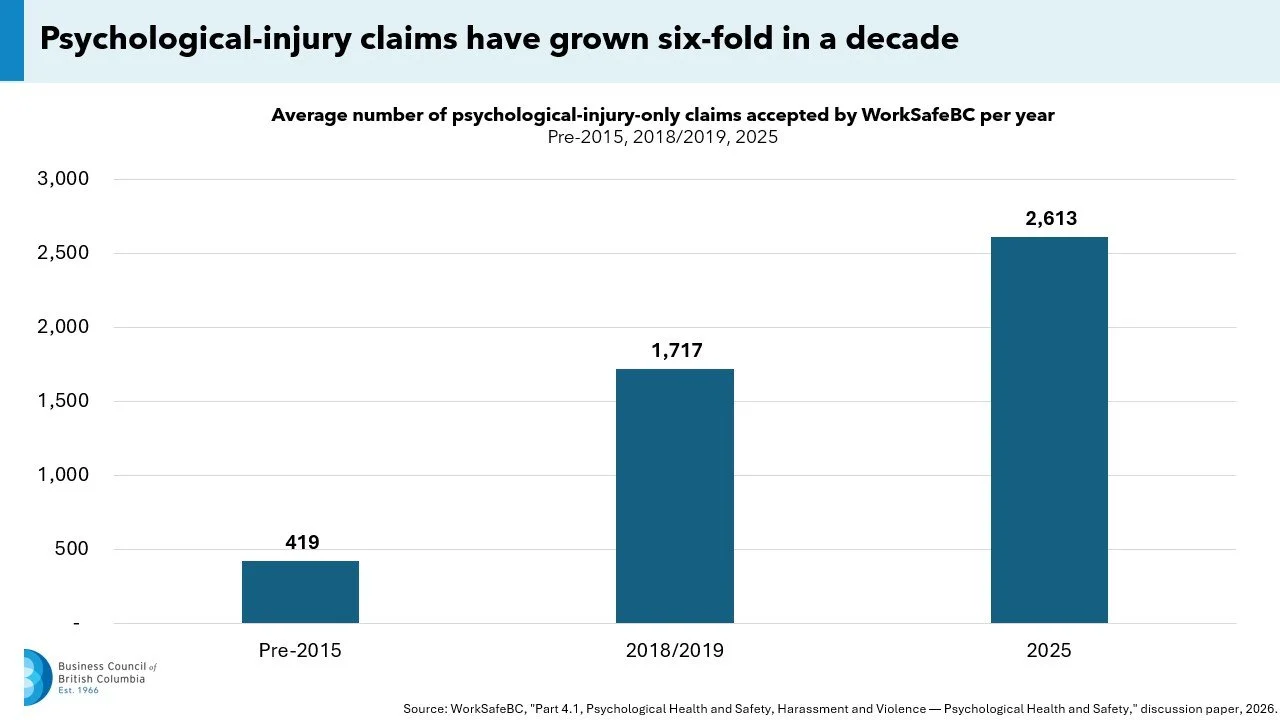
One area that typically has long and complex claims is psychological injury claims, which have grown roughly six-fold in a decade, among the fastest-growing cost pressures in the system.
WorkSafeBC's response to rising psychological injury claims is a new proposed regulation that would make every B.C. employer legally responsible for eliminating or minimizing the risk of psychological injury at work.
The regulation applies a preventative framework built for measurable physical hazards to a risk no one can objectively measure, so employers can't know when they've complied and inspectors have no consistent standard to enforce.
The better path is to support employers through practical guidance and established voluntary standards (like CSA Z1003), and to protect good-faith management decisions, so ordinary calls on workload and feedback can't become safety violations.
Introduction
Every business in B.C., from a café to a sawmill, pays into WorkSafeBC, the public insurer that covers workplace injuries for workers. Over the last decade, the underlying cost of running B.C.'s workers' compensation system has been climbing faster than the premiums employers pay to fund it.
Employers haven't felt the full weight of that yet, because the increase has been cushioned, by reserves built from employers' past contributions, by strong investment returns, and by a cap that limits how fast any industry's rate can rise in a single year. But those buffers are running down. The average premium rate has been held flat for a decade and is now projected to rise in 2028, for the first time since 2014, as the system's true cost keeps climbing, from about $1.67 per $100 of payroll in 2020 to a projected $1.96 by 2031.1
One of the main reasons costs are rising is that injury claims are lasting longer and getting more complex. One area that typically has long and complex claims is psychological injury claims, which have grown roughly six-fold in a decade, among the fastest-growing cost pressures in the system. In this context, WorkSafeBC is proposing a sweeping new regulation requiring every employer to eliminate or mitigate the risk of psychological injury at work.
The proposed regulation asks employers to eliminate or mitigate risks that can be difficult to define and assess objectively, while WorkSafeBC has yet to demonstrate that this approach will reduce the psychological injury claims contributing to rising system costs. Employers already operate under existing rules, such as the requirement to maintain a bullying-and-harassment policy, and many go further on their own, offering employee assistance programs and other mental-health support. This paper sets out why costs are rising, why psychological claims sit at the centre of that trend, and why this regulation is the wrong response to it.
The cost problem underneath
Between 2015 and 2025, B.C. headline inflation averaged about 3 per cent per year. Both premium and investment income (what funds the system) grew at 5 per cent per year, reflecting both payroll growth and strong investment returns. But WorkSafeBC's claim costs grew about 9 per cent per year and its long-term disability costs almost 13 per cent per year. This is roughly three to four times the pace of inflation and nearly double the growth in the income that primarily funds the system (Figure 1). A system whose costs compound at nearly twice the rate of its revenue cannot hold its price indefinitely.
The increase in the cost of running the system is not because B.C. workplaces are more dangerous. In fact, the time-loss claims rate (i.e., the number of injuries serious enough to keep a worker off the job per 100 person-years of employment) fell from 2.22 in 2015 to 2.04 in 2025 (Figure 2). Relative to the size of the workforce, fewer workers are being injured. And that’s good news.
Figure 1
But then if the frequency of time-loss claims is falling, why are costs climbing? Part of this is policy driven from a few years ago. In 2022, the province adopted Bill 41, the Workers Compensation Amendment Act (No. 2), which restored full inflation-indexing of benefits. Because these benefits are indexed and long-term disability is paid out over decades, about $9.8 billion of WorkSafe's obligations now move with inflation, and each additional percentage point of annual inflation adds roughly $98 million in cost. In addition, Bill 41 drove a one-time $1.2 billion increase in WorkSafe's benefit liabilities when it was implemented. On top of that, in 2023 WorkSafe booked a new $697 million provision for latent occupational disease, an entirely new category of liability.
But another big source of pressure is that claims are lasting longer and becoming more complex. The average short-term claim now runs around 11 days longer than in 2021 and about 70 per cent of that increase in duration comes from chronic pain and psychological injury claims.2 Psychological injury claims themselves have grown six-fold in a decade (Figure 3). These claims tend to run long, and longer claims cost more, which is why they are among the fastest growing pressures on the system.
Figure 2
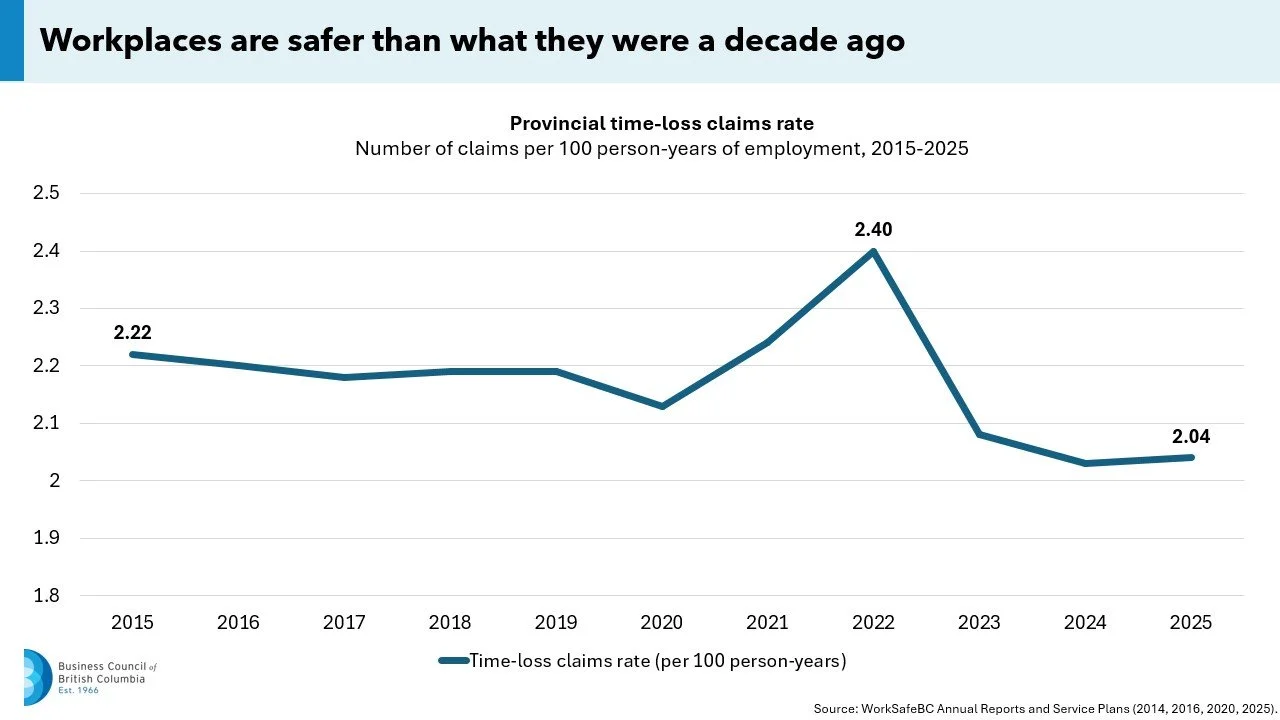
Figure 3
WorkSafeBC's answer: regulating a risk the system can't measure
Faced with the costs of rising psychological injury claims, WorkSafeBC is proposing a new psychological health and safety regulation that would require every B.C. employer to eliminate or minimize the risk of psychological injury at work. Before imposing it though, we should ask whether it will reduce those claims, what it will cost, and how compliance can objectively be assessed.
The draft regulation broadly defines a "psychosocial hazard" as “any workplace or work-related hazard that could expose a worker to the risk of psychological injury, including a hazard that arises from one or more of the following: traumatic circumstances and events to which workers could be exposed during the course of their work, the design and management of work, the physical work environment, and equipment.”
Under the regulation, every employer would have to identify these hazards, prepare a written risk assessment, eliminate these risks or, if not doable, reduce each one to the "lowest level practicable," review it at least annually, and train and consult workers on an ongoing basis.
A major problem with this approach is that it assumes psychological risks can be identified and controlled at a workplace through an occupational health and safety framework used to manage physical hazards. For example, a frayed cable lying across the floor is a hazard you can see, measure against a standard, and fix. Psychological risk, on the other hand, can depend heavily on context, individual circumstances and perceptions, and some contributing factors can sit outside the workplace and outside an employer's control. Importing the physical-hazard prevention framework onto psychological risk makes compliance impossible for employers to pin down.
That mismatch creates three problems. First, because of the subjective nature of these risks and the vagueness of the regulations, no business can really know when it has complied. For instance, WorkSafeBC includes as examples of one of the categories (“design and management of work”) things like workload, work pace, job demands "too high or too low," and how people are supervised.
Consider some examples. A manager sets a tight deadline to hit a client commitment. Was that an uncontrolled "workload" hazard? A supervisor gives someone hard feedback. Did that "supervision" create a psychological risk? A company runs short-staffed through a slow quarter. Is understaffing a hazard it failed to control? Is a restaurant slammed on a Friday night creating a psychological hazard? Reasonable people can assess the same circumstances differently in good faith. What matters in regulation is how an employer or inspector determines objectively where ordinary workplace pressures end and a regulatory violation begins. Once these operational realities become hazards employers need to control, every decision becomes a compliance question.
Second, the proposed rules would create uncertainty around managerial decisions already subject to other legal and contractual requirements. Workload, staffing, hours, supervision are core management calls, and many of them are already covered by the Employment Standards Act and, in unionized workplaces, by collective agreements under the Labour Relations Code. The regulation lays a new, subjective standard on top: a shift that's perfectly lawful, or a workload a union already agreed to, could still be second-guessed as an inadequately controlled "psychosocial hazard." WorkSafeBC's own harassment provisions, in the very same regulatory package, expressly state that a good-faith management action is not harassment. The psychosocial-hazard provisions include no equivalent protection.
Third, it's a guaranteed cost for an unproven benefit. Every employer in the province takes on new assessments, documentation, training, and consultation, and there are legitimate questions whether this will actually reduce psychological claims.
If adopted, this regulation might have the potential to significantly disrupt the nature and culture of workplaces. For example, emergency rooms, kitchens, trading floors, mining and drilling sites are all high-pressure work environments. Pressure itself cannot simply be regulated away from many jobs. The concern is that ambiguous standards could encourage defensive management practices, particularly where demanding workloads, urgent decisions and difficult feedback are inherent to the work. Employers need to know that reasonable, good-faith management decisions will not inadvertently become occupational health and safety violations.
Conclusion and recommendation
None of this is a crisis. WorkSafeBC is well funded, its investments are performing, and workplaces are not getting more dangerous. But the premium rate increasingly understates what the system actually costs to run. That gap has been manageable because surplus funding and rate caps have absorbed part of it. The projected increase in the average premium rate beginning in 2028 is an early sign of that pressure surfacing.
The problem is that the underlying cost pressures are not going away. Claims costs and long-term disability costs have been growing considerably faster than the income funding the system. Psychological and chronic-pain claims are contributing to that pressure by making claims longer and more expensive. Unless that underlying cost trend is addressed, the pressure on rates will grow and the answer shouldn’t be for employers to shoulder an ever-rising bill but rather to tackle what's driving the cost.
Against that backdrop, the draft psychological health and safety regulation adds a universal new cost without any clearly demonstrated benefits, and applies an occupational health and safety framework to risks that are much harder (or even impossible) to define, assess and control. Supporting worker mental health is a real and worthy goal, but this regulation will create more problems than the one it's trying to solve.
Rather than a new enforceable duty measured against every management decision, WorkSafeBC should support the psychological-health work employers are already doing, through practical, industry-specific guidance and established voluntary standards like the National Standard of Canada for Psychological Health and Safety in the Workplace (CSA Z1003). And whatever approach is taken, it must protect good-faith management, so that ordinary decisions on workload, scheduling, and feedback cannot be recast as safety violations, a safeguard WorkSafeBC already built into the harassment provisions in this very regulatory package, but left out of the psychological-hazard rules.
The broader point is that WorkSafeBC already has an underlying cost problem. Before adding another obligation to employers, WorkSafeBC should be able to show how this regulation’s effectiveness will be measured, what compliance will cost employers, and how businesses can objectively know when they have met their obligations. At the same time, it needs to show how it will contain the costs already rising underneath it. On the evidence presented so far, it hasn't, and it's asking employers to pay for a fix that isn't one.