
Update on Canada-U.S.A. Tariffs
Following significant developments in recent days, we wanted to provide an update on where things stand and what the latest tariffs mean for Canada and British Columbia.
BCBC President and CEO Laura Jones was in Washington, D.C., over the weekend, where she had conversations with Canada’s ambassador to the United States and other business leaders. These conversations made clear that Canada’s negotiating team worked tirelessly to reach an agreement and was deeply disappointed when the latest U.S. terms made a deal untenable. They also reinforced BCBC’s view that the Prime Minister made the right decision by walking away.
On Friday evening, following the breakdown in negotiations, BCBC issued a statement and immediately began speaking with media outlets in Canada and around the world, helping share the Canadian business perspective. This included weekend coverage on BBC television and radio, Al Jazeera, CKNW, CTV, Global and CBC, among others.
Watch some of our interviews
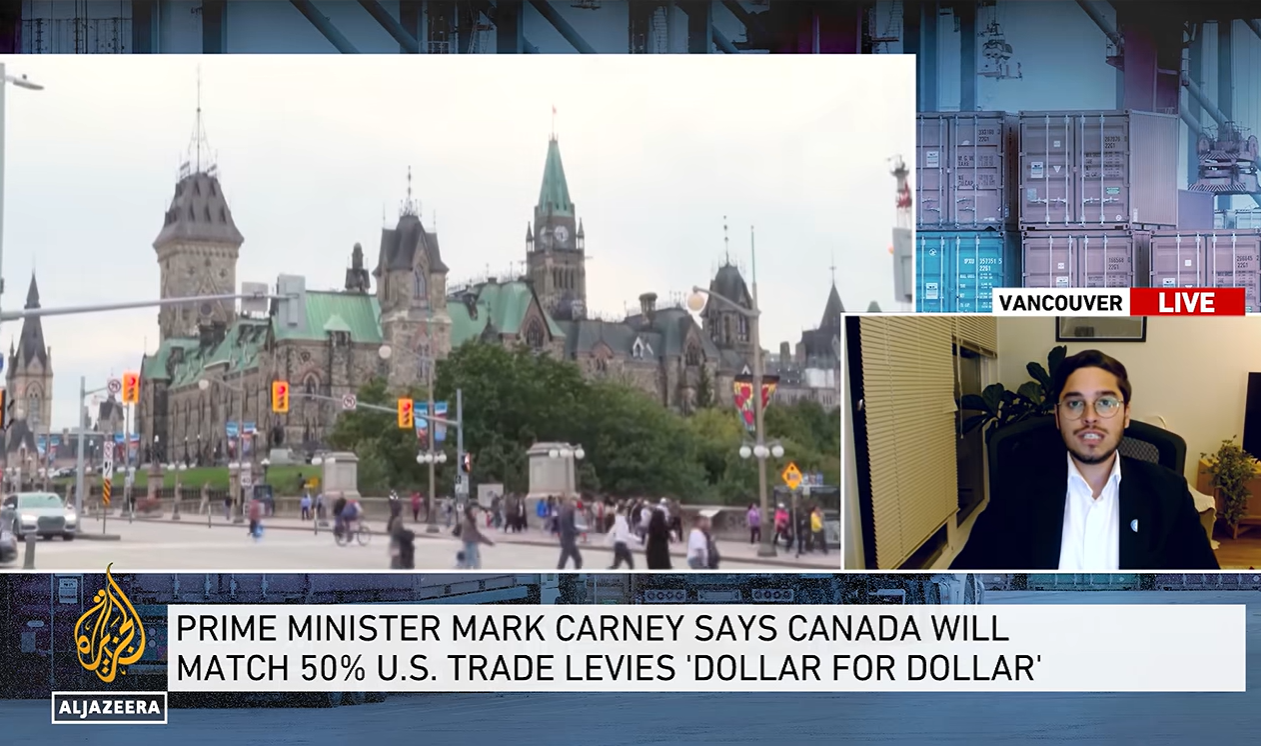
This week, we are continuing to engage with members to identify specific tariff-related impacts, emerging concerns and barriers preventing businesses from investing and growing at a time when Canada needs it most. These insights will help inform our advocacy with governments and our public communications in the weeks ahead.
If your organization is being affected by the tariffs, or if there are specific actions governments could take to support investment and growth, please let us know.
Where things stand
New U.S. Section 338 tariffs took effect Saturday, August 22, imposing a 50% tariff on approximately $28 billion in Canadian goods. These are in addition to existing tariffs on steel, aluminum, lumber, and autos.
A recent survey has found that 76% of Canadians supported Prime Minister Carney’s decision to abandon talks, while two-in-five are concerned about their jobs as a result.
CUSMA remains in force until 2036, and approximately 80% of Canadian exports continue to enter the United States duty-free under the agreement.
National impact
The new U.S. tariffs affect approximately 5% of Canada’s exports to the United States.
The Canadian value-added content of the affected goods represents approximately 0.4% of GDP, with an estimated 90,000 jobs potentially at risk.
Canada’s average effective U.S. tariff rate is expected to rise from approximately 3% to 6%. Canada will no longer have the lowest rate among major U.S. trading partners, although it remains below the U.S. average of nearly 7% globally.
The most affected sectors include plastics, electrical machinery, furniture and wood products, with impacts concentrated in British Columbia, Quebec and Ontario.
Impact on British Columbia
B.C. is the most exposed province, with approximately 14% of its U.S.-bound exports affected. This represents roughly $3.8 billion in trade, and an estimated 11,000 jobs potentially at risk.
B.C.’s average effective U.S. tariff rate is expected to rise from approximately 3.5% to 10%
Nearly two-thirds of B.C.’s exposure is concentrated in machinery, electronics, and forest products. Machinery and electrical equipment alone account for approximately $1.5 billion.
The 10 most affected products account for approximately 60% of B.C.’s exposure. Electrical control boards and panels lead the list at more than $900 million, followed by products including veneer sheets, refined lead, televisions and cameras.
Retaliatory Tariffs & Business Supports
Ottawa also announced $7.5 billion in support for tariff-affected businesses and workers, intended to provide liquidity, support market and supply-chain diversification, encourage investment and help retain workers.
Canada will impose counter-tariffs of 15%, 25% and 50% on $27.6 billion in U.S. imports beginning September 8.
The counter-tariffs will raise costs for Canadian businesses. Industrial supplies ($16.5 billion) and capital goods ($6.7 billion) account for 84% of the affected imports.
BCBC analysis finds that approximately $3.17 billion in B.C. imports from the U.S. are covered, led by metals and metal products ($769 million), machinery and electronics ($591 million), food and agriculture ($532 million), wood and paper ($481 million), and transportation equipment ($418 million).