
Canada’s trade ambitions depend on reliable labour relations
Introduction
Canada cannot control every external shock or the trade policy decisions made by its largest trading partner, but we can control more of the conditions at home that determine whether Canadian businesses can compete and reach new markets. For example, a more reliable federal labour relations framework is one part of Canada’s competitiveness agenda that is within our control.
Canada has also set ambitious economic goals: become the strongest economy in the G7, double exports to non-U.S. markets over the next decade, and become an energy superpower. Achieving those ambitions will require, among many other things, a reliable and stable federal labour relations framework in trade-enabling sectors Canadian businesses depend on.
Labour disruptions in these sectors have impacts that extend far beyond the bargaining parties. When postal service stops, important deliveries for Canadians are delayed. When an airline shuts down, Canadians can be stranded and miss important events in their lives or work because of cancelled flights, while the export of time-sensitive, high-value goods is grounded. When ports or railways stop moving, Canadian businesses wait for much needed inputs and exporters miss delivery windows.
The consequences also extend beyond our borders. Customers around the world expect Canadian products to arrive when promised and not delivering negatively affects our reputation. With the United States waging a trade war against Canada and new U.S. tariffs targeting Canadian exports, our stated goal of doubling trade to non-U.S. markets has become more urgent. However, a country trying to rapidly diversify its trading partners to reduce reliance on a single market cannot afford to develop a reputation as an unreliable supplier because its critical transportation networks frequently become unavailable due to a work stoppage.
Canada stands out internationally
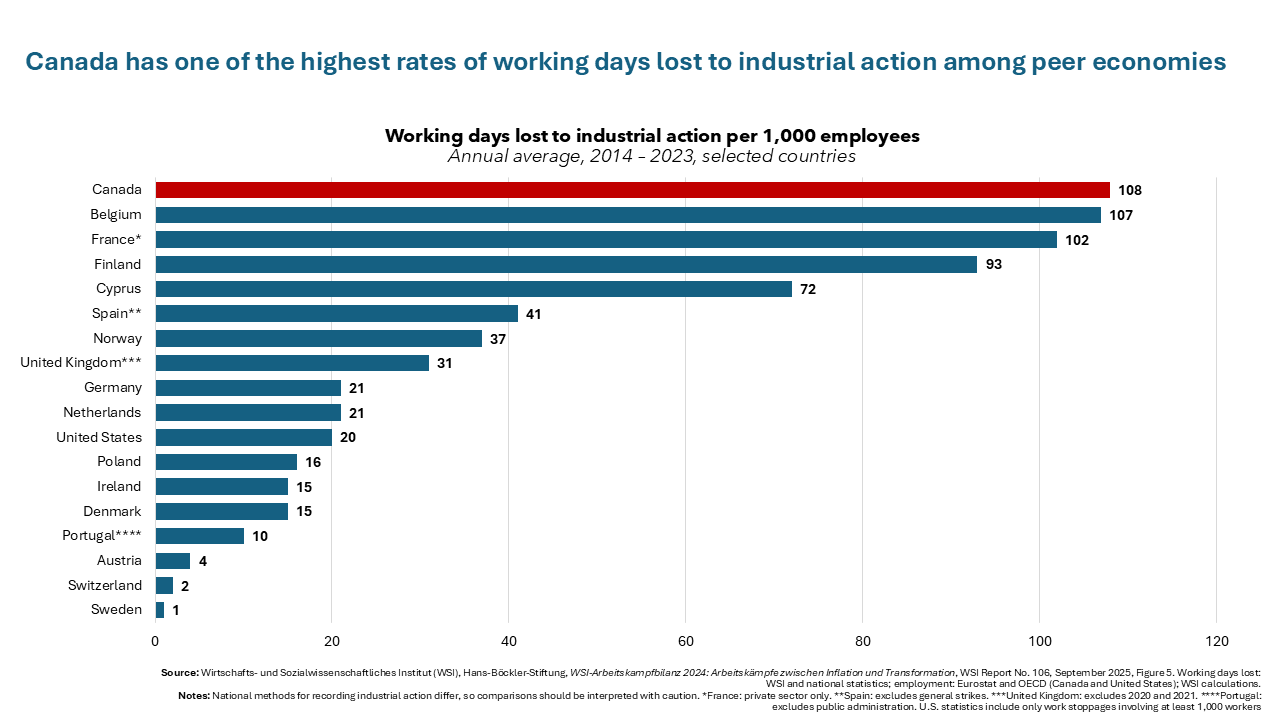
One way to compare work stoppages across countries is to measure working days lost to labour disruptions per 1,000 employees, which adjusts for differences in workforce size. Over the 2014–2023 period, Canada averaged 108 working days lost per 1,000 employees annually. This is the highest rate among the five countries in the G7 with available data and among a broader group of 18 advanced economies with available and comparable data shown in Figure 1. Differences in national reporting practices mean the results should be interpreted as an indication of relative strike activity rather than a precise country ranking. [1]
Figure 1
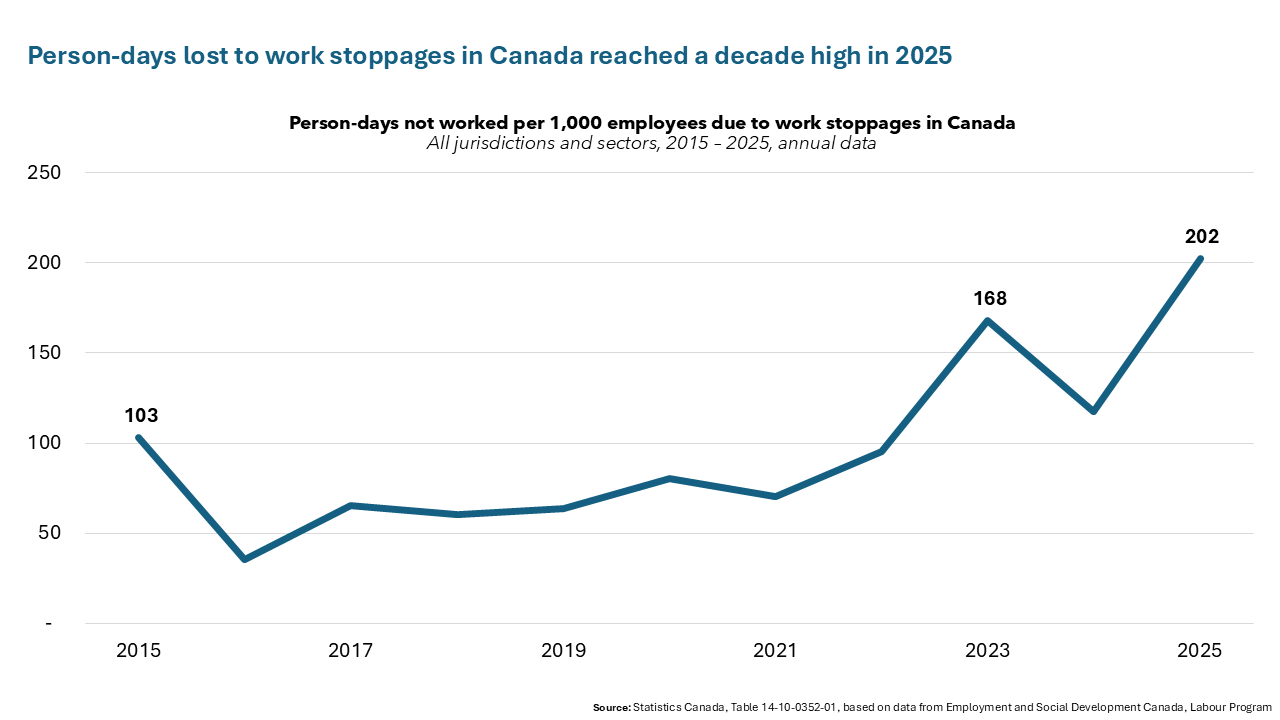
Statistics Canada data tell a similar story. StatsCan uses a related but different metric called person-days not worked due to strikes and lockouts. A “person-day not worked” measures the direct working time lost by employees involved in a strike or lockout. Adjusting for increases in Canada’s workforce, the number of person-days not worked per 1,000 employees rose to roughly 202 in 2025, well above the levels recorded through much of the previous decade (Figure 2).
Figure 2
The disruption is concentrated
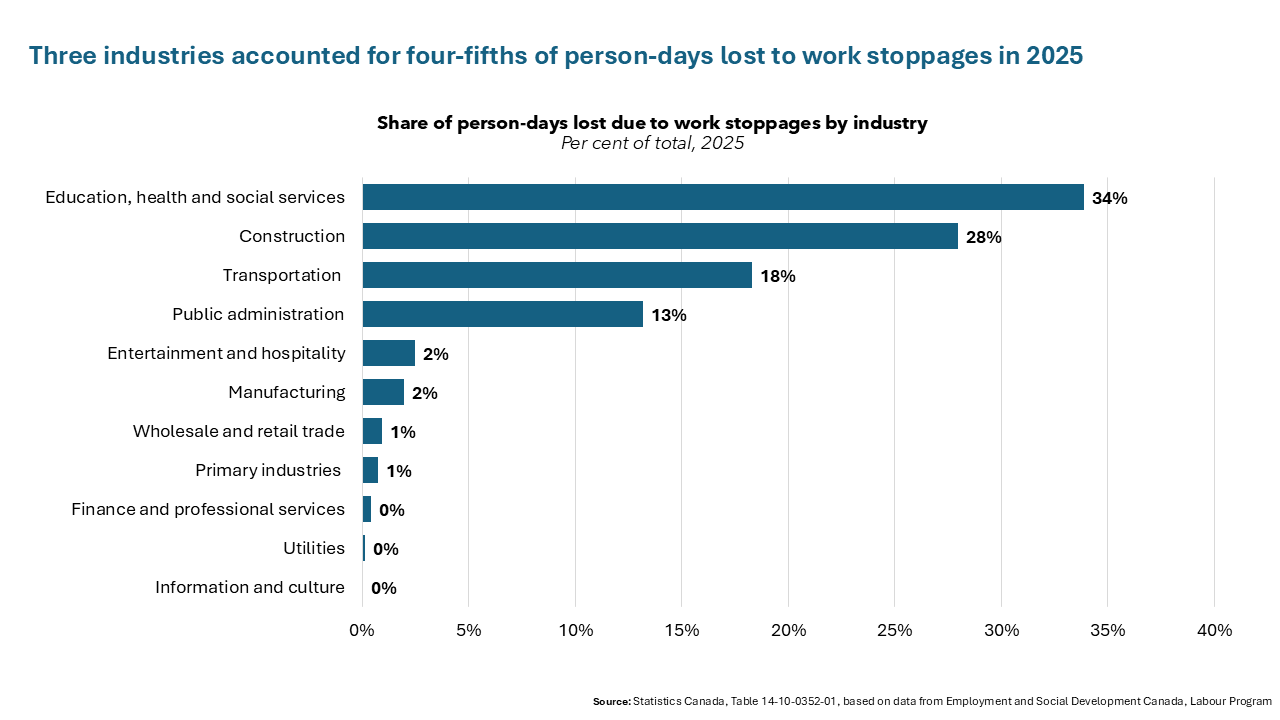
The recent increase is not evenly distributed across the economy. In 2025, education, health and social services accounted for about one-third of person-days lost, construction for more than one-quarter, and transportation for close to one-fifth (Figure 3). Together, those three sectors accounted for roughly 80% of the total. This concentration is expected, given their large workforce sizes and significantly higher unionization rates compared to other industries.
Figure 3
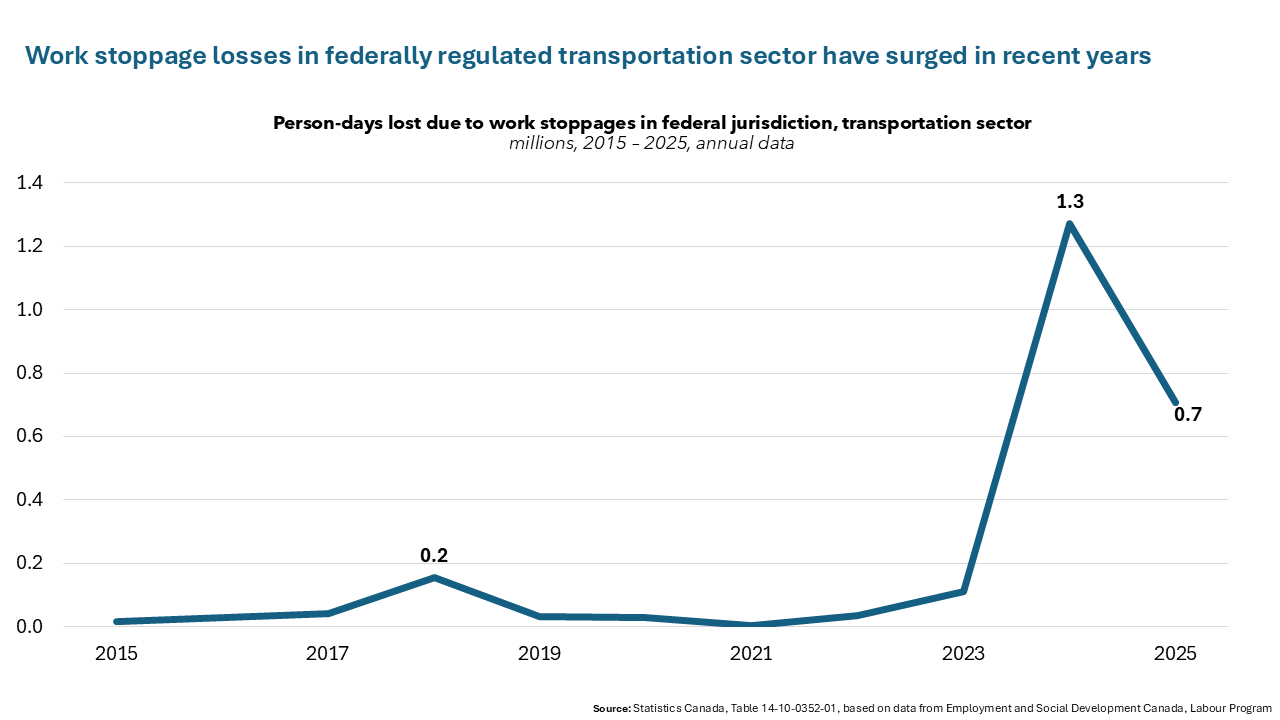
Labour relations in the first two sectors are governed under provincial labour codes. But stoppages in the federally regulated transportation industry are an important part of that picture. It covers many of the networks that connect provincial economies to each other and to global markets. These include railways, ports, aviation, interprovincial transportation, telecommunications and other nationally significant infrastructure. Recent person-days lost in federally regulated transportation have also risen significantly compared with much of the previous decade (Figure 4). [2]
Figure 4
The costs extend beyond the bargaining table
The more important point is that labour disruptions in trade-critical infrastructure can become national economic risks. Most labour disputes directly involve an employer and its workers. But the economic consequences of a work stoppage at a major port, railway, or other critical network extend far beyond the bargaining table.
For example, a rail disruption can leave manufacturers waiting for critical inputs. A port shutdown can prevent forestry, mining, and other exporters from reaching overseas customers, while importers and retailers face delays. These effects cascade through supply chains. The resulting message this disruption sends to an international customer is that Canada did not deliver when it said it would, regardless of what happened at the bargaining table.
This is also why the number of work stoppages or person-days lost cannot, on its own, tell us how economically significant a dispute is. A stoppage at a highly concentrated gateway can interrupt billions of dollars of trade and affect businesses and consumers across the country. For example, a recent economic impact study estimated that Canada’s West Coast ports handled $409 billion worth of goods in 2025 (about $1.1 billion on an average day). More importantly for Canada’s trade diversification agenda, $281 billion of that was merchandise trade with countries outside North America.
In other words, the economic importance of a labour disruption depends not only on how many workers stop working or for how long, but on where in the economy that disruption occurs.
This matters for Canada’s labour productivity. Ports, railways and other trade infrastructure allow businesses and workers elsewhere in the economy to be productive. When equipment sits idle, workers wait for inputs, exporters reroute goods and businesses devote resources to managing disruption instead of producing and investing.
A more reliable federal labour relations framework
The Business Council of British Columbia (BCBC) has argued for a federal framework that preserves collective bargaining and the right to strike while improving predictability and reducing the risk that bargaining breakdowns become national economic disruptions. Our recommendations work at different stages of the bargaining process.
First, the bargaining structure at West Coast ports needs an update. Ports largely operate as an integrated labour market but separate bargaining units add complexity and unpredictability to the bargaining process. The 2025 Industrial Inquiry Commission on West Coast ports has identified this gap and recommended a B.C.-wide geographic certification. In simple terms, this would bring bargaining at our West Coast ports under a common structure, with local issues still addressed locally but major shared issues negotiated at one industry-wide table under one collective agreement. West Coast ports are the only ports in the country where bargaining doesn’t operate this way. The goal here is to better align the bargaining structure with the integrated way the ports themselves operate.
Our second recommendation comes in the middle of the bargaining process. We believe there should be more support when negotiations reach a serious impasse but before a strike or lockout begins. We support the Commission's proposed special mediator process, which would give the parties another structured opportunity to reach a settlement. The mediator would examine the outstanding issues and recommend settlement terms in a public report, with strikes and lockouts paused while that work is underway and for a short period afterward.
And third, we recommend the federal government create an explicit statutory authority for Cabinet to compel binding arbitration as a last resort in critical trade-enabling sectors. BCBC proposes limiting that authority to rail, ports, aviation and interprovincial pipelines, and only where bargaining has occurred and is failing, less restrictive alternatives have been tried or are unavailable, and the disruption poses a systemic risk to the Canadian economy.
Conclusion
Together, the three reforms address different points of failure: geographic certification improves the bargaining structure, special mediation provides additional support before a dispute escalates, and binding arbitration provides a defined mechanism for resolving disputes before they put Canadian livelihoods at risk. With the next round of collective bargaining at West Coast ports expected to begin in November 2026, the window to implement these necessary reforms is rapidly closing.
If Canada wants to become more productive, diversify its exports, and strengthen its position as a reliable supplier to the world, the infrastructure that connects Canadian businesses to their customers has to work reliably.
[1] Countries differ in the types and size of work stoppages captured, sectors covered, treatment of strikes and lockouts, and methods used to estimate days lost. For example, the United States reports only major work stoppages involving 1,000 or more workers; the French data exclude much of the public sector; Spain excludes general strikes; Portugal excludes public administration; and the United Kingdom series excludes 2020 and 2021. Italy and Japan were not included. As a result, small differences between countries should not be interpreted as statistically or economically meaningful, and the figures are best used to compare broad patterns rather than establish a definitive international ranking.
[2] Federal transportation category includes postal services, so the recent spike should not be interpreted as a measure of disruption at ports and railways alone given Canada Post’s recent strikes.