
Q&A: WorkSafeBC’s Psychological Health and Safety Proposal
The following Q&A is intended to provide a clearer understanding of WorkSafeBC’s Draft Psychological Health and Safety Regulation, including what is being proposed and what it could mean for B.C. workplaces.
The proposed regulation: what it would do
Q: What is being proposed?
A: WorkSafeBC has released for consultation a draft regulation, Part 4.1 — Psychological Health and Safety, that would create an enforceable duty on every B.C. employer to eliminate or minimize the risk of psychological injury at work. It applies the same prevention approach used for physical hazards to a new category called "psychosocial hazard." Due to the provincial election, consultations have been paused until further notice.
Q: Why is WorkSafeBC doing this?
A: WorkSafeBC points to a sharp rise in accepted psychological-injury claims, from roughly 419 a year before 2015 to about 2,613 in 2025. It notes these claims tend to last longer and cost more, and states its goal is to prevent them at the source rather than only compensating them after the fact. The regulation's approach assumes these claims may be driven by workplace conditions that employers can identify and control.
Q: What counts as a "psychosocial hazard"?
A: The draft defines it broadly as “any workplace or work-related hazard that could expose a worker to the risk of psychological injury,” across four categories:
Traumatic circumstances and events,
The design and management of work,
The physical work environment, and
Equipment in the workplace.
Q: What does WorkSafeBC say each category covers?
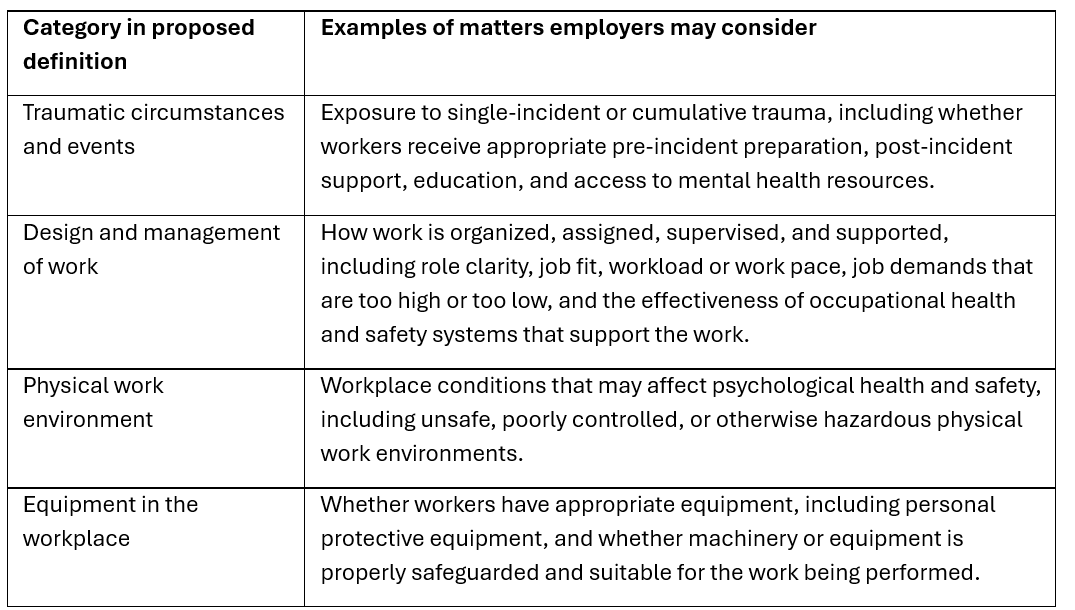
Q: What would businesses actually have to do?
A: According to the proposed regulation, employers would now have four continuing duties:
Identify psychosocial hazards and prepare a written risk assessment.
Eliminate them or if not practicable, reduce the risk to the "lowest level practicable."
Review the assessment at least annually and evaluate the effectiveness of control measures whenever the workplace changes significantly.
Provide ongoing worker training and consult worker representative and/or joint health and safety committee throughout.
Q: What documents would a business have to keep?
A: The regulation doesn't set out a document list, but because compliance would be demonstrated largely through records, in practice an employer would likely need to produce and keep current:
A written risk assessment for each hazard,
Records of the control measures taken,
An annual review log,
Records of any reassessment triggered by workplace changes,
Training records, and
Records of consultation with the joint committee.
BCBC’s assessment: why this is the wrong approach
Q: What is BCBC’s core concern with the regulation?
A: WorkSafeBC's prevention system was built to manage objective, discrete, and physical risks. Physical hazards can be seen, measured, and controlled to a verifiable standard. Psychosocial hazards are subjective, continuous, and contested. In our view, applying the physical-hazard framework to psychological risk makes compliance impossible to define. That mismatch is the source of the three specific problems below.
Q: What could this look like in practice?
A: In each of the following scenarios, an ordinary business decision could be second-guessed as an inadequately controlled "psychosocial hazard”:
A manager setting a tight deadline to meet a client commitment.
A supervisor giving an employee critical performance feedback.
A company running short-staffed through a slow quarter to manage costs.
A restaurant rush on a Friday night.
An employer restructuring a team or changing reporting lines.
A reasonable employer and a reasonable worker can look at the same situation and disagree in good faith, and an inspector, a Review Officer, and the Workers' Compensation Appeal Tribunal could each land somewhere different. That is the core of the problem: the regulation turns routine management into a series of compliance questions no one can answer with confidence.
Q: What specific problems does that create?
A: First, it's hard to know when a business has complied. "Design and management of work" is subjective, and "lowest level practicable" has no objective endpoint for something like workload the way it does for a physical hazard. Employers face real uncertainty and enforcement becomes a matter of an inspector's judgment rather than measurement.
Second, it intrudes on management decisions and overlaps with existing legislation. Workload, staffing, hours of work, scheduling, and supervision are core management responsibilities. Several of these are already governed by the Employment Standards Act (ESA) and, in unionized workplaces, by collective agreements under the Labour Relations Code. The proposed regulation layers a subjective standard on top of those regimes. For example, a shift that is lawful under the ESA, or a workload permitted under a collective agreement, could still be treated as an inadequately controlled "psychosocial hazard."
Third, it's a certain cost against an unproven benefit. Whether regulation of this kind actually reduces psychological claims has yet to be proven by evidence. The compliance cost, by contrast, is immediate.
Q: Does the draft regulation protect good-faith management decisions?
A: Not for psychosocial hazards. Proposed updates to bullying and harassment provisions expressly state that a good-faith management action, such as performance management or direction of work, is not harassment. The psychosocial-hazard provisions contain no equivalent protection. An ordinary decision, assigning a deadline, adjusting a workload, giving hard feedback, could be second-guessed as an inadequately controlled hazard, with no good-faith defence written in.
Q: Does this change the nature of work in demanding industries?
A: It could. Some work is intense by its very nature. Emergency rooms, protective services, trading floors, mining and drilling sites, newsrooms, kitchens, construction sites, and professional services are all high-pressure environments. Our concern is that the regulation treats ordinary demands of this type of work not as operational realities, but as hazards an employer is legally obligated to eliminate or minimize to the "lowest level practicable."
Q: Does this ask employers to manage workers' mental health, and what does that do to the workplace relationship?
A: In practice, it moves in that direction. Employers and managers are not trained psychologists. The concern is that it makes managers hesitant to give constructive feedback or assign urgent work for fear of triggering a complaint. And because work stress and personal stress are deeply intertwined, an employer trying to determine whether a psychological injury is genuinely "work-related" is drawn into judgments about an employee's life outside work that it is not well placed to make.
Q: How does this compare to other places?
A: Other jurisdictions that regulate psychological injury risk give employers a cost-versus-benefit safety valve. The federal government, the United States, and Australia all use a "reasonably practicable" standard, which lets an employer weigh the cost of a control measure against how much risk it actually removes. WorkSafeBC’s "lowest level practicable" standard, as WorkSafeBC's own guidance appears to apply it, weighs only the level of risk and the available controls, not cost, so there is no point at which an employer has clearly done "enough."
Q: Can WorkSafeBC even enforce this?
A: In our view, not consistently. Prevention officers are trained to inspect physical standards (e.g., air quality, machine guards, or scaffolding). They have no objective tools or benchmarks to evaluate whether an employer’s workload distribution or management style has been reduced to the "lowest level practicable". The same unanswerable judgment would run all the way up the chain, through Review Officers and the Workers' Compensation Appeal Tribunal, none of whom have a defined standard to apply.
Q: What does BCBC propose instead?
A: Protecting workers’ psychological health is an essential economic and societal objective, but this regulation is fundamentally the wrong mechanism. Employers take worker mental health seriously, and many are already acting on it through expanded benefits, Employee and Family Assistance Programs (EFAPs), wellness initiatives, and flexible work arrangements.
We think this draft should be withdrawn. If WorkSafeBC regulates in this area at all, it should take the approach the federal government uses with a general, program-based duty to consider psychological health, rather than a hard, enforceable standard that no one can define or measure.
WorkSafeBC should pivot from enforcement to supporting employers through established voluntary frameworks like the National Standard of Canada for Psychological Health and Safety in the Workplace (CSA Z1003) and focus on providing practical guidance and toolkits rather than creating new mandates.
Most importantly, whatever approach is taken must explicitly protect good-faith management decisions, so that routine operational choices, performance reviews, scheduling, and workload assignment cannot be classified as safety violations.