
Breaking Down B.C.’s 2026 Budget
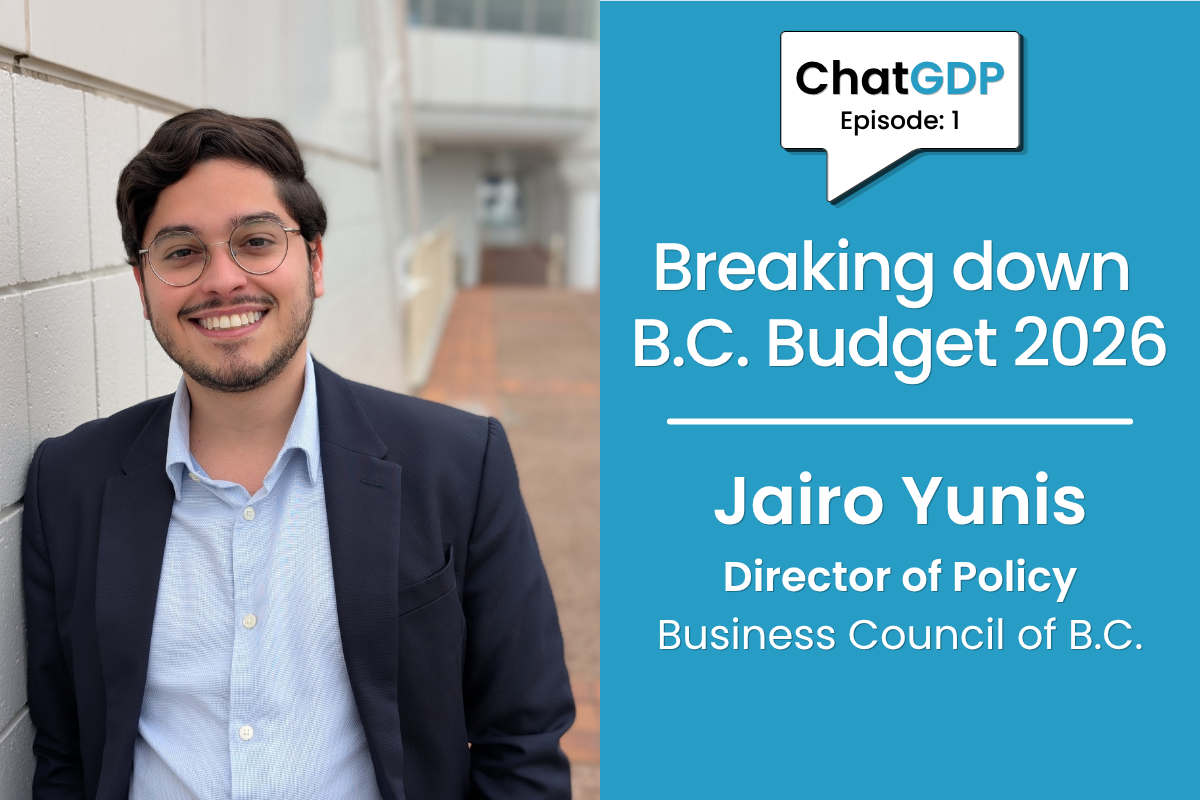
A conversation with BCBC’s Director of Policy, Jairo Yunis. This conversation has been lightly edited for clarity and length.
Q: You were in Victoria for the budget. What was your overall takeaway?
Yes, my colleague David Williams and I spent almost four hours in the [budget] lockup, and we were shaking our heads for most of it.
At a high level, two things stood out. First, the speed and scale of the province’s fiscal deterioration. The province went from a triple-A credit rating and a nearly $1 billion budget surplus in 2022/23 to a record $13.3-billion deficit in the current fiscal year.
As a share of GDP (2.9 per cent), this is the highest deficit in the country. In addition, taxpayer-supported debt is on track to nearly triple on a per-person basis from roughly $12,000 in 2021/22 to nearly $33,000 by 2028/29.
And second, the absence of a credible plan to stabilise the trajectory we’re on despite tax hikes and modest efficiency measures. We outlined some of these concerns following the budget.
Q: You mentioned per-person debt tripling by the end of the decade. How much are British Columbians paying to service that debt?
It's a number that should give people pause. By 2029, every British Columbian will be paying over $1,500 per year just to service government debt. That's almost triple the long-run average of around $530 per person.
Debt servicing is the fastest-growing line item in the entire budget. If it were a ministry, it would rank as the third largest. The province now spends more on interest than it allocates to the Ministry of Social Development and Poverty Reduction. And that matters because none of that is going to things like health care, education, or tax relief. It’s just money down the drain.
Q: What are the biggest concerns from an economic standpoint?
The most immediate concern is the negative signal this budget sends to businesses and families considering investing, hiring, or settling in B.C. When you're running deficits of this magnitude with no clear path back to balance, some combination of further tax increases and spending cuts is likely unavoidable down the road. That kind of signal has a chilling effect on the economic decisions we need people to make.
Making it all worse is the growth backdrop. The B.C. economy is expected to grow at 1.3 this year and around 1.8 per cent per year over the next two years, well below its long-run average of 2.5 per cent. Without stronger private-sector activity, revenues aren't going to ride to the rescue. We need to be doing everything we can to raise those growth rates.
Q: One of the biggest reactions has been to the PST expansion. Why is that such a concern?
Yea, I've been hearing from many BCBC members about this one directly, and the frustration is real. The government plans to apply the PST to many professional services like engineering, accounting, and commercial real estate which are essential inputs into building housing, developing projects, and running a business. And when you make it more expensive to hire an accountant or an engineer here than in Alberta, where there's no PST, you create a real disincentive for economic activity.
We actually joined forces with over a dozen other business groups following the budget to publicly express our concerns at a joint press conference. Together, we called on the province to reverse course on this change because of how harmful it will be to our economy.
The deeper problem is structural. The PST works very differently from the HST (Harmonized Sales Tax) used in most other provinces. Under an HST, businesses can claim input tax credits so the tax doesn't compound through the production chain. The PST offers no such relief. That's a big part of why B.C. has the highest marginal effective tax rate on new investment in the country.
Q: The government would argue that expanding the PST is needed to fund services. How do you respond to that?
The best way to protect public services over the long run is to acknowledge we have a spending problem, not a revenue problem. Raising taxes is a short-term fix to a long-term problem.
If spending keeps growing faster than the economy, and we rely on borrowing and tax increases to fill the gap, we weaken the economic base that funds those services in the first place.
Instead, we need to be focused on growing our economy, which in turn will generate more revenue for the province over the long-term, protecting the services British Columbias need.
Q: You’ve also talked about the impacts on entrepreneurship and investment. What does that look like in practice?
When the [business] environment feels stable and costs are predictable, entrepreneurs take risk and start businesses, expand, and/or hire. When taxes go up and the outlook gets murkier, they pull back and the tax base grows slower. Rinse and repeat.
The conversations I'm having with business leaders reflect real hesitation about what comes next. Over time, that chilling effect on investment may translate to weaker productivity and slower employment growth.
We explored this in more detail in a recent BIV opinion piece.
Q: There’s also been some discussion about the messaging coming out of this budget. What was the message to the business community?
Sometimes budgets are more about the signals they send than the actual numbers. They send a message to investors, businesses, and households about the direction of government’s priorities.
In this case, the message has been completely muddled. On one hand, there’s an acknowledgment of economic challenges. But on the other hand, the policy choices being made will deter private sector investment and do nothing to get us back on a path to a more sustainable fiscal footing.
My colleagues Laura Jones and Braden McMillan actually wrote an op-ed on this topic last month if you want to learn more.
Q: Last question. Thinking broadly, what would BCBC have liked to see in this budget instead of what we got?
In advance of the budget, we joined other business associations to urge the province to make improving British Columbia’s economy a top priority. Together, we made three recommendations.
First, we asked the province to exempt all capital investment from the PST. B.C. has the highest marginal effective tax rate on new capital investment in Canada and exempting capital inputs from PST would align B.C.’s PST disadvantage with the rest of the provinces.
Second, we asked for a credible plan to cut the deficit in half within three years and a return to taxpayer-supported debt to sustainable levels. Without a plan to reduce the deficit, the province sends negative signals to households and businesses that taxes will need to be higher in the future to stabilize the government’s fiscal situation.
Finally, we also asked the government to show leadership when it comes to removing interprovincial trade barriers. It’s an easy, yet effective, way to stop standing in our own way as a province.
More from BCBC on this topic: