
Understanding Reconciliation and Recent Legal Developments in B.C.
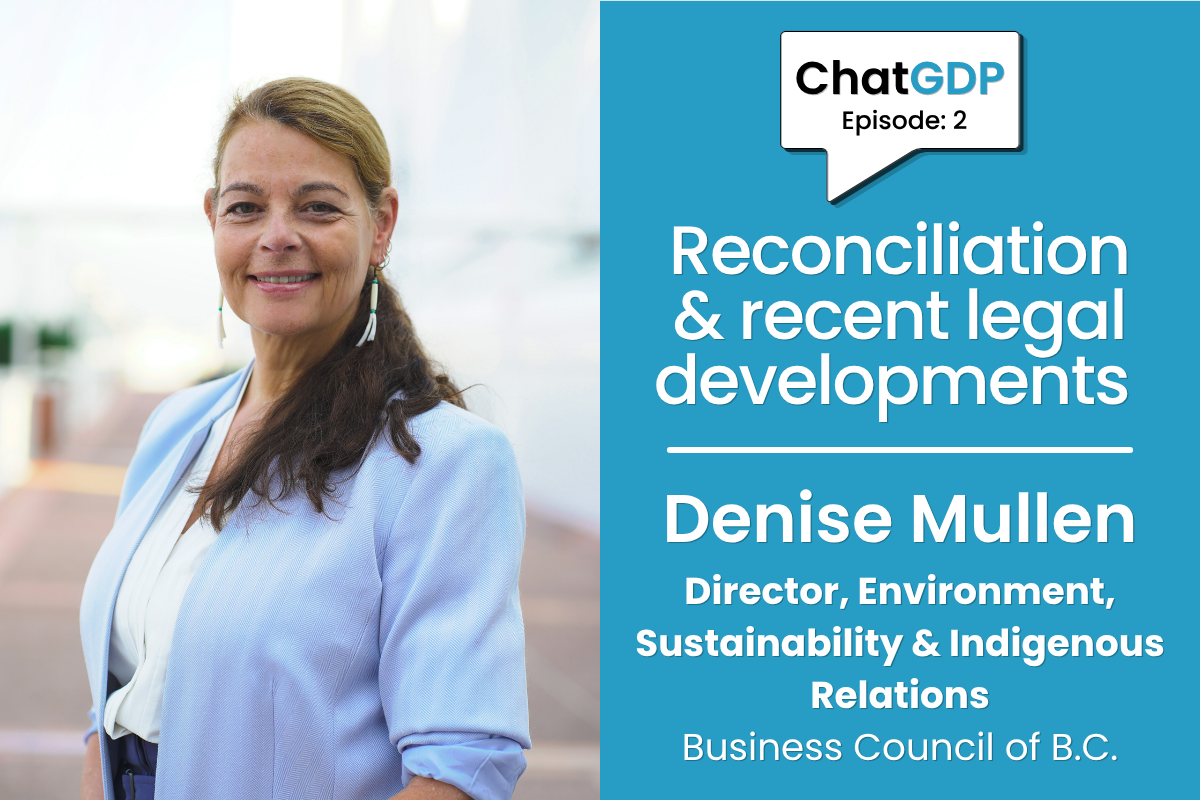
A chat with BCBC’s Director of Environment, Sustainability & Indigenous Relations, Denise Mullen. This conversation has been lightly edited for clarity and length.
Q: There’s been a lot of attention on recent court decisions. What’s actually going on right now?
The legal ground is shifting in ways that should concern everyone in British Columbia and creating significant economic uncertainty.
Recent [court] decisions, including Cowichan Tribes v. Canada and Gitxaala Nation v. British Columbia, are reshaping how laws related to land, ownership, and decision-making are being interpreted. And they’re doing so without a clear framework to guide those changes.
The issue isn’t that courts are doing something wrong. They’re interpreting the law as it exists. The problem is that governments haven’t spelled out how reconciliation commitments and existing property rights are meant to work together.
So, what we are seeing are major questions about land, ownership, and authority being worked out case by case in the courts. That creates real and immediate uncertainty.
Q: Why does that uncertainty matter so much?
Because it strikes at the foundation of how our economy works.
Everything from housing to infrastructure to small businesses depends on secure land ownership and predictable rules. That’s what allows people to invest, borrow, and plan ahead.
When that foundation is called into question, even indirectly, the impacts are immediate. That’s when we have lenders reassess risk, investors taking a pause, and projects getting delayed or not moving forward at all.
And it’s happening. We are hearing from businesses, and financial institutions are pulling back and adjusting how they approach projects and lending because the rules are no longer clear. B.C. is increasingly becoming uninvestible.
At the same time, the province is facing serious fiscal challenges. The last thing we should be doing is introducing additional risk into the system that underpins economic growth.
Q: Where do DRIPA and UNDRIP fit into this?
They’re central to it.
DRIPA (The Declaration on the Rights of Indigenous Peoples Act) commits the province to aligning all laws with UNDRIP, which is the United Nations Declaration on the Rights of Indigenous Peoples. But UNDRIP is an aspirational international instrument, not a treaty or binding international law. Canada already has some of the strongest constitutional protections for Indigenous rights in the world and this adds another layer of complexity and uncertainty.
So, the question was never whether we needed to adopt new obligations and whether layering UNDRIP onto existing constitutional law was required. And because we did not spend the time defining how they would interact, we are now witnessing how this ambiguity creates serious consequences for B.C., both legally and in terms of the economy.
The courts are using UNDRIP via DRIPA as an interpretive tool in ways that go beyond what many people understood as the purpose of the Act when it was introduced and adopted. And now it is fundamentally changing how land is treated, how decisions are made, and what “consent” means in practice.
What began as a global policy ideal is now actively reshaping how laws are interpreted without clear guidance from elected governments on how this should happen.
Q: You mentioned consent. How big of an issue is that?
It’s a major issue, and it’s not well understood.
There’s a fundamental difference between consultation and consent.
Consultation means governments must engage, listen, and consider impacts before making decisions. That’s already part of Canadian law.
Consent is a fundamentally different standard. You get to say no. This means a government that is supposed to balance the interests of all British Columbians when it makes decisions will be prevented from making those decisions without agreement from Indigenous people.
This has significant implications. It changes who ultimately has authority in decision-making and how competing interests are balanced. Those questions should be answered by elected governments through open and accountable process not delegated to bodies that don't represent the broad interests of all British Columbians or who people cannot vote for.
Q: A lot of people assume these issues only affect Crown land. Is that accurate?
That’s one of the concerns. Crown land is absolutely central because our land base is 94 per cent public. It’s a foundation of our economy, our wealth, and our public revenues. The current legal issues put all this at risk, meaning billions of dollars of projects, infrastructure, and public land management.
But it’s not just public land. It [court cases] also affect private [land]. What makes the Cowichan decision alarming is that private land is now exposed to uncertainty. There has always been a general assumption that private land was on a different footing than Crown land, but this is now not the case.
Even if these private land questions are ultimately resolved in a way that protects landowners, the damage is already done. The uncertainty created by the decision alone is enough to have real impacts that will be felt for years to come.
The ripple effects go far beyond Crown land. Homeowners, businesses of all sizes, and communities across B.C. are affected. Mortgages, land titles, and property values are all being called into question as a result of these recent decisions.
Q: What are you hearing from businesses directly?
We’re hearing a growing level of concern, or even alarm, I would say at this point.
Businesses are delaying investment decisions. Lenders are reassessing their exposure. Some projects are struggling to secure financing, while others are being cancelled altogether. It’s very concerning.
At the same time, there is strong support for reconciliation, and many businesses are actively working in partnership with Indigenous communities.
The challenge with the current approach is the level of uncertainty it’s creating. That makes it difficult to invest, build, and grow. This isn’t just a tougher environment to navigate. In many cases, it’s becoming unworkable.
Q: Is the business community aligned on how to respond?
There’s a range of views, but there is increasing alignment on one point: the current situation is not sustainable.
Some believe DRIPA should be repealed. Others, including BCBC, believe it should be substantially amended to provide clarity. It should be clearly defined as an aspirational framework for advancing reconciliation, with clear boundaries and grounded in our system of democratic accountability. It was never intended to function as a legally enforceable standard, and that must be made explicit.
What’s consistent across these perspectives is a shared recognition that reconciliation is essential and must continue, but the current approach is not working. It is creating serious challenges for investment, economic growth, and ultimately the province’s fiscal health. The status quo is not working and doing nothing is not an option.
Q: Where does BCBC stand specifically?
We supported the aspirations behind UNDRIP and supported DRIPA based on the understanding, shared by many at the time, that Canada’s constitutional framework would remain paramount and that implementation would be clearly defined within it.
At the time, we also had clear assurances from government that DRIPA would not create new rights, would not have legal force, would not affect private land, and would not amount to a veto over development. And we expected those assurances to be backed by a concrete plan and a clear vision for what reconciliation would look like in practice.
What we’re seeing now is very different.
The way DRIPA and UNDRIP are now being applied and interpreted bears little resemblance to what was originally communicated. Access to Crown land and public resources is increasingly in question. Decision-making authority is being reshaped.
Our view is that this needs to be addressed urgently. That means meaningful amendments to provide clear guidance on how DRIPA is applied, where the limits are, and how it fits within Canada’s constitutional framework.
We absolutely want to see practical economic reconciliation move forward, and we are working with Indigenous communities to help inform our policy positions. But it requires a foundation of clarity, legal certainty, and public trust. Right now, that foundation is not there.
Q: Let’s talk specifically about the Cowichan decision, since it has received significant attention in the media. Why is it so concerning?
Because it introduces uncertainty around something that has always been considered foundational: private property rights.
Even just the possibility that private land could be subject to competing claims creates risk. And risk is immediately reflected in how lenders, investors, and markets respond. They don’t wait for an appeal to be decided. The damage is done the moment the question gets raised and that’s what we saw happen in this case.
Private property owners in Richmond, including homeowners and business owners, are concerned. So are the investors and lenders involved in projects there.
That’s why we’ve called for the strongest possible appeal and a stay of judgment. There needs to be clarity as quickly as possible in this case.
Q: The Cowichan Tribes have said this isn’t about taking private property. Does that address the concern?
We appreciate the assurances provided by the Cowichan Tribes. However, when it comes to something as fundamental as private property rights, legal certainty is essential.
This decision has established a legal precedent that could extend far beyond Richmond and have implications across British Columbia. Property owners, businesses, and investors rely on clear and secure land title. That certainty cannot depend on interpretation or assurances; it requires a clear legal framework that protects both reconciliation and economic stability.
Q: What should governments be doing right now?
The priority should be restoring clarity and confidence.
That starts with pursuing the [appeal] process and seeking a stay.
But the government also needs to do what they should have done before DRIPA was passed, and that is developing a clear and pragmatic framework about how reconciliation is to be implemented. How do we move forward together so that the rights and interests of all British Columbians are respected.
It’s this framework that is missing and that needs to be addressed in short order.
Q: Big picture—can reconciliation and economic growth still move forward together?
Yes. There is no reason they can’t.
Across B.C. there are countless examples of businesses and Indigenous communities working together effectively and we see the desire to continue this progress from all involved. Reconciliation and economic growth are not in conflict. But they both need clarity, and that is what is missing right now