
B.C. Youth Hit Hardest by Labour Market Weakness
British Columbia’s labour market is showing growing signs of strain. Job creation has slowed. The unemployment rate is climbing. Most new positions are in the public sector, while private sector hiring has fallen well below historical trends (see B.C.’s Lagging Job Creation Indicates a Weakening Economy and Private vs Public: A Tale of Two B.C. Job Markets). Amid broader weakness, young British Columbians are being hit hardest.
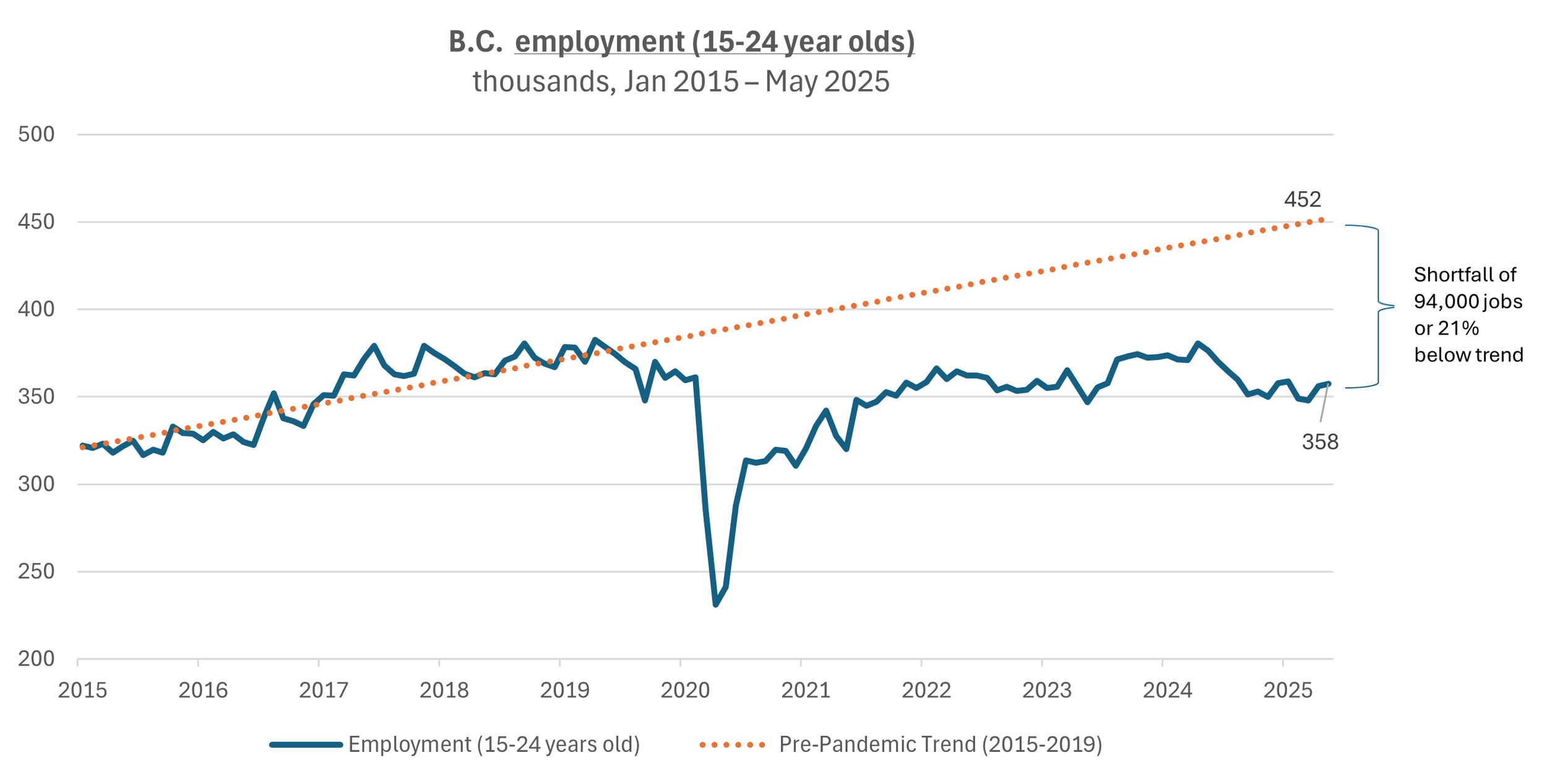
Had employment among 15–24-year-olds continued along its pre-pandemic growth trajectory (2015–2019), B.C. would have approximately 452,000 young workers employed today. Instead, as of May 2025, the number stands at just 358,000, a gap of 94,000 jobs, or 21% below trend (Figure 1).
Figure 1: Youth employment in B.C. remains far below pre-pandemic trend
Source: Statistics Canada. Table 14-10-0287-01 Labour force characteristics, monthly, seasonally adjusted.
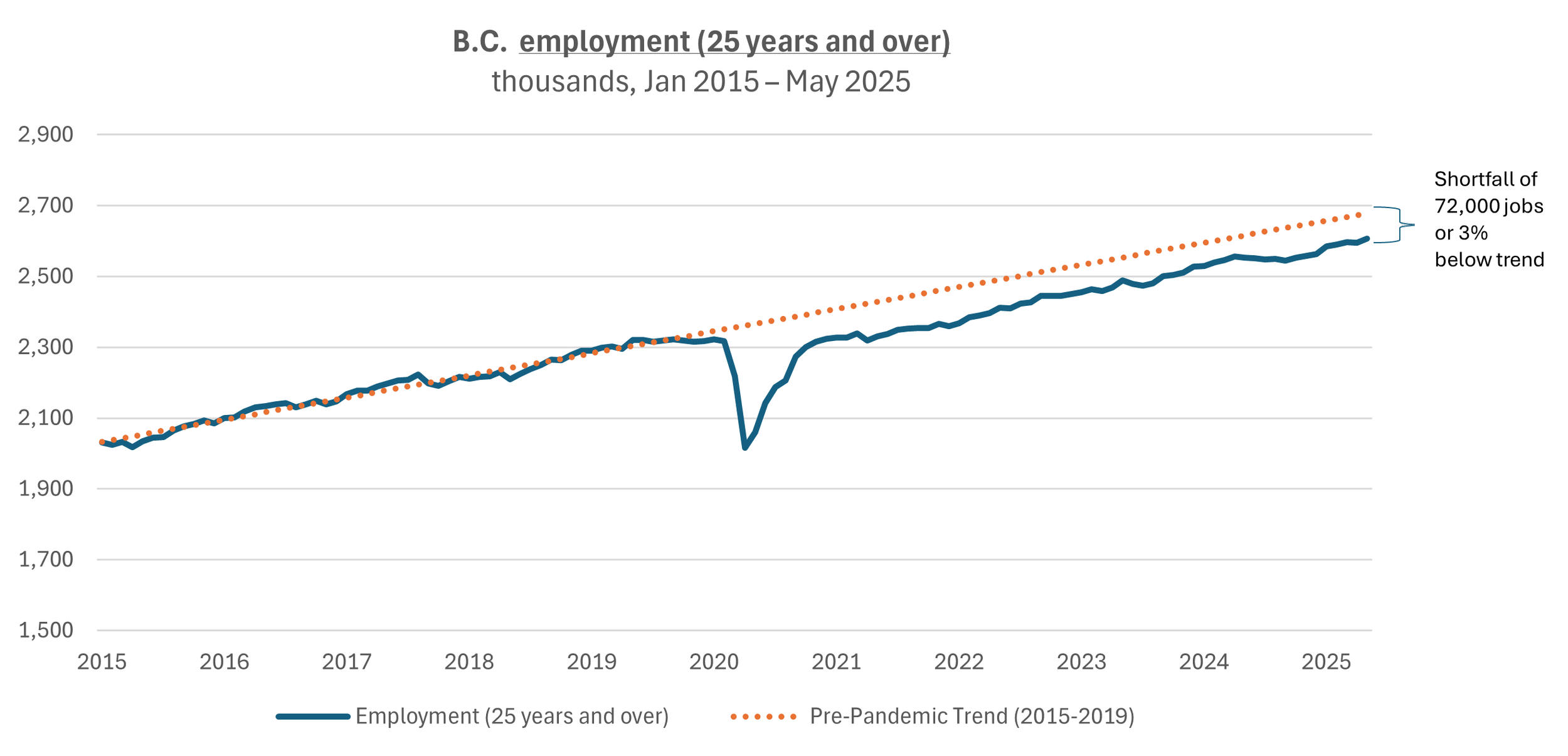
By contrast, employment among those aged 25 and over is 3% below its pre-pandemic trajectory (Figure 2). In total, the gap in youth employment accounts for 57% of all “missing jobs” in the province (i.e., missing relative to the pre-pandemic trajectory).
Figure 2: Employment among British Columbians 25 years and over is tracking close to trend
Source: Statistics Canada. Table 14-10-0287-01 Labour force characteristics, monthly, seasonally adjusted.
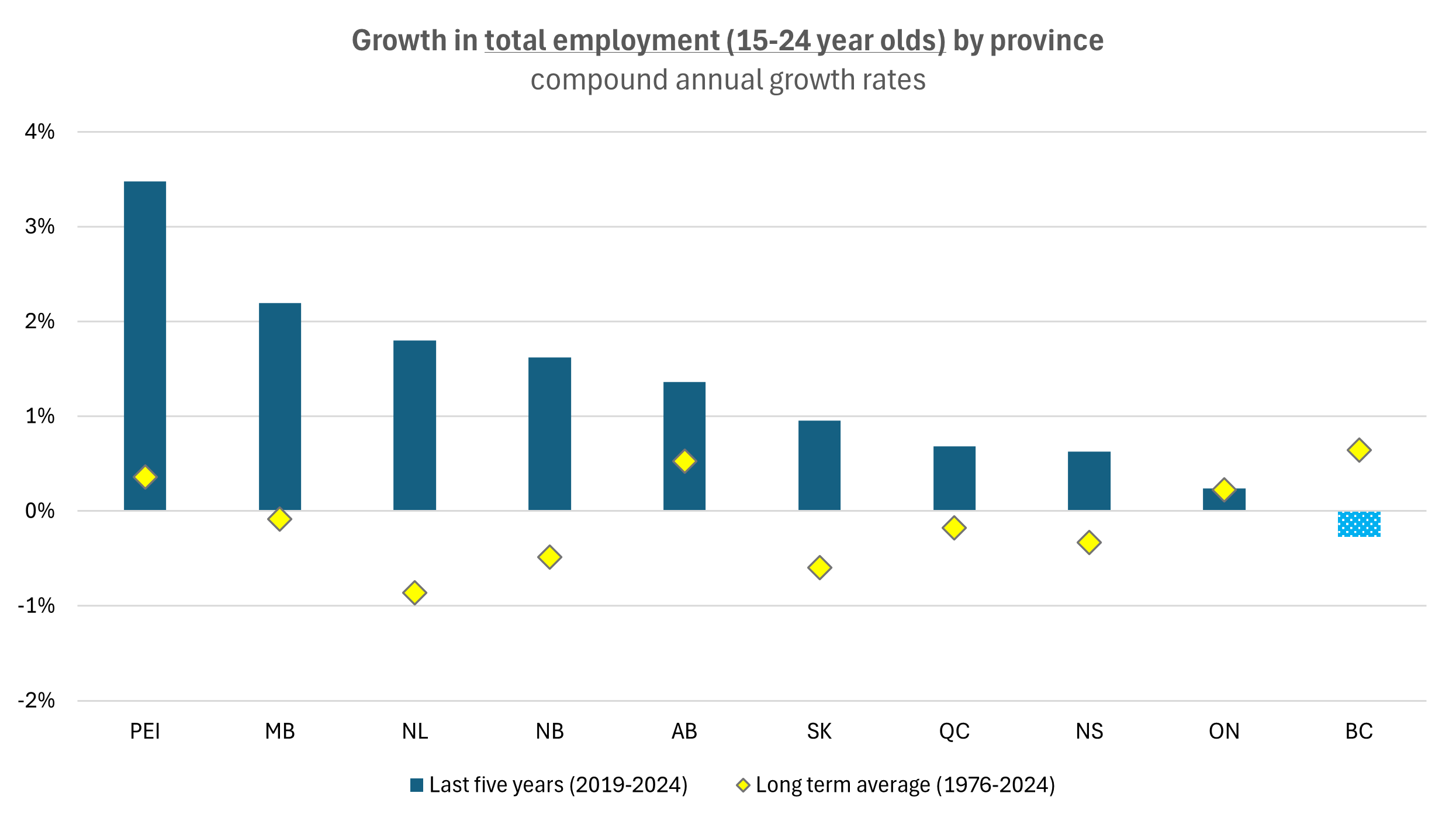
Over a longer time horizon, the slowdown in employment growth for young people becomes even starker. Between 1976 and 2024, youth employment in B.C. grew at a compound annual growth rate (CAGR) of 0.6%, which was the fastest of any province over that period. However, B.C. is the only province where youth employment failed to recover from the downturn of 2020-21. In fact, it is the only province to record a negative growth rate in youth employment over 2019-2024 (Figure 3).
Figure 3: B.C. is the only province where youth employment failed to recover from the 2020-21 pandemic downturn
Source: Statistics Canada. Table 14-10-0023-01 Labour force characteristics by industry, annual (x 1,000).
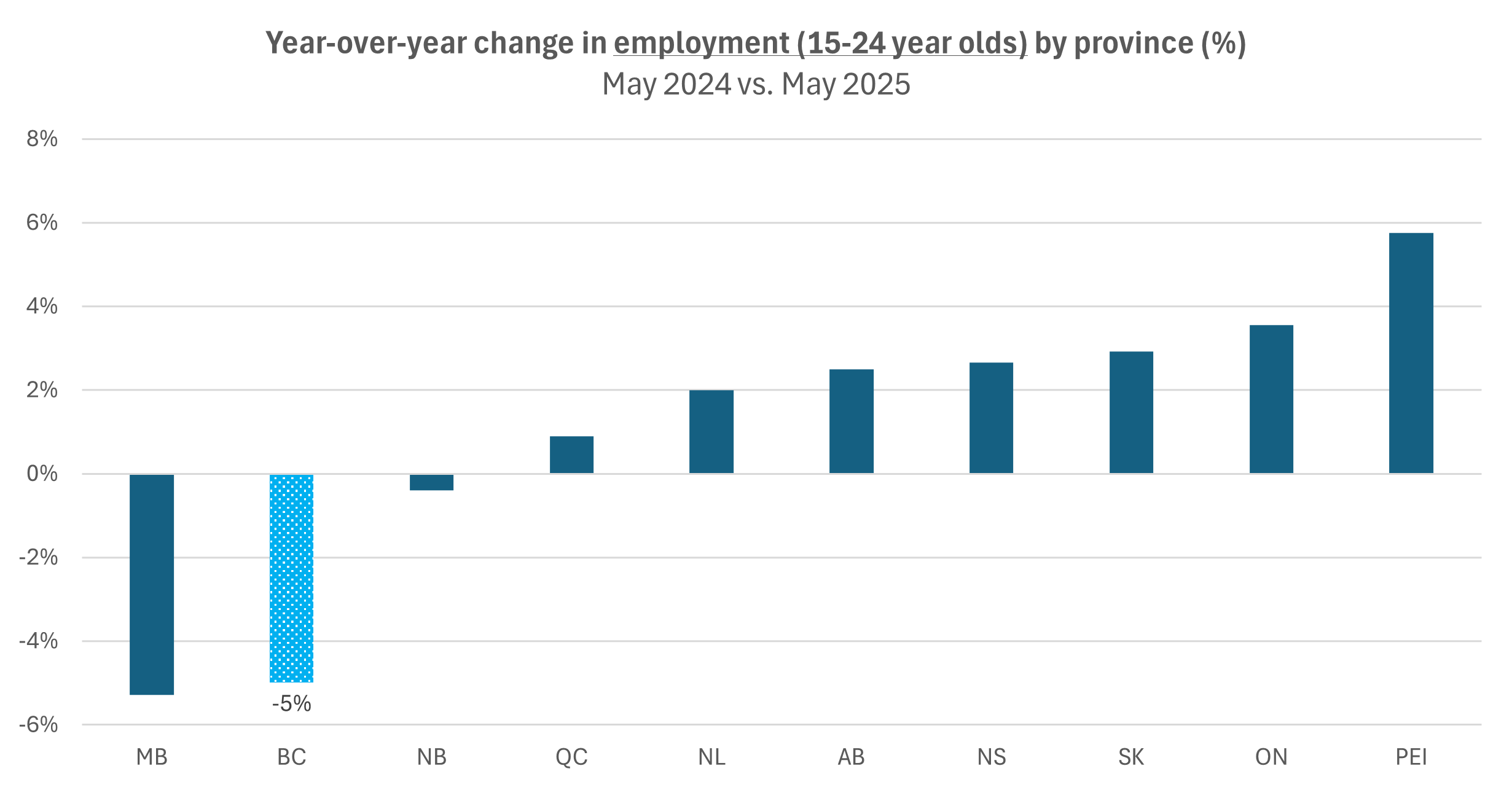
More recent numbers also show the deterioration of B.C.’s youth labour market. Between May 2024 and May 2025, the number of employed young people fell by 5%, marking the second largest annual drop among provinces after Manitoba (Figure 4).
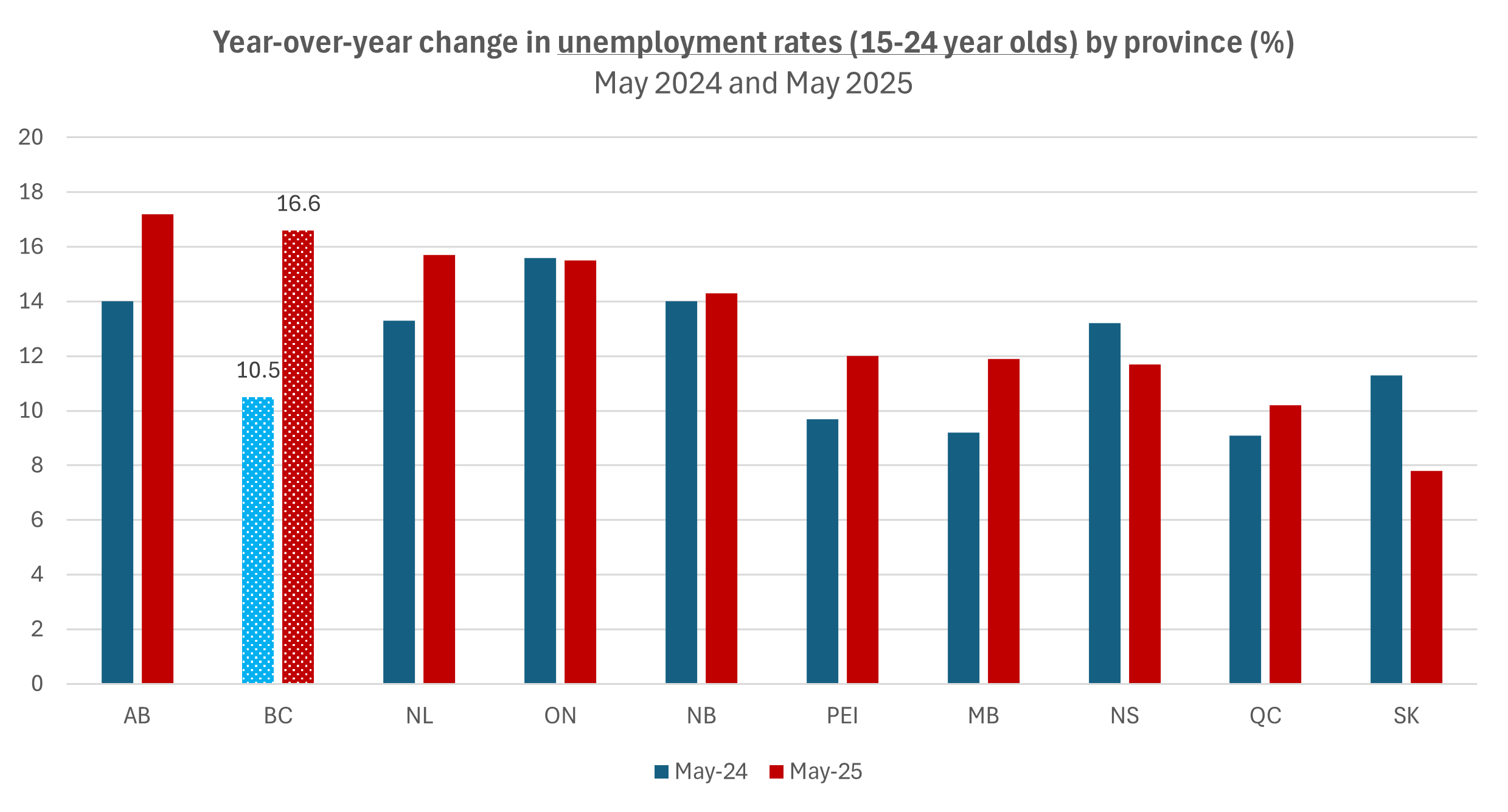
This deterioration is reflected in the youth unemployment rate. In May 2024, the unemployment rate for 15–24-year-olds in B.C. was 10.5%. One year later, it had climbed to 16.6% (a 6.1 percentage point increase). B.C. has seen the largest increase in the youth unemployment rate of any province over the past 12 months (Figure 5). B.C. also has the second highest youth unemployment rate in the country behind Alberta.
Figure 4: B.C. has seen the second-steepest decline in youth employment among provinces over the past 12 months
Source: Statistics Canada. Table 14-10-0287-01 Labour force characteristics, monthly, seasonally adjusted.
Figure 5: B.C. posted the largest increase in the youth unemployment rate of any province over the past 12 months
Source: Statistics Canada. Table 14-10-0287-01 Labour force characteristics, monthly, seasonally adjusted.
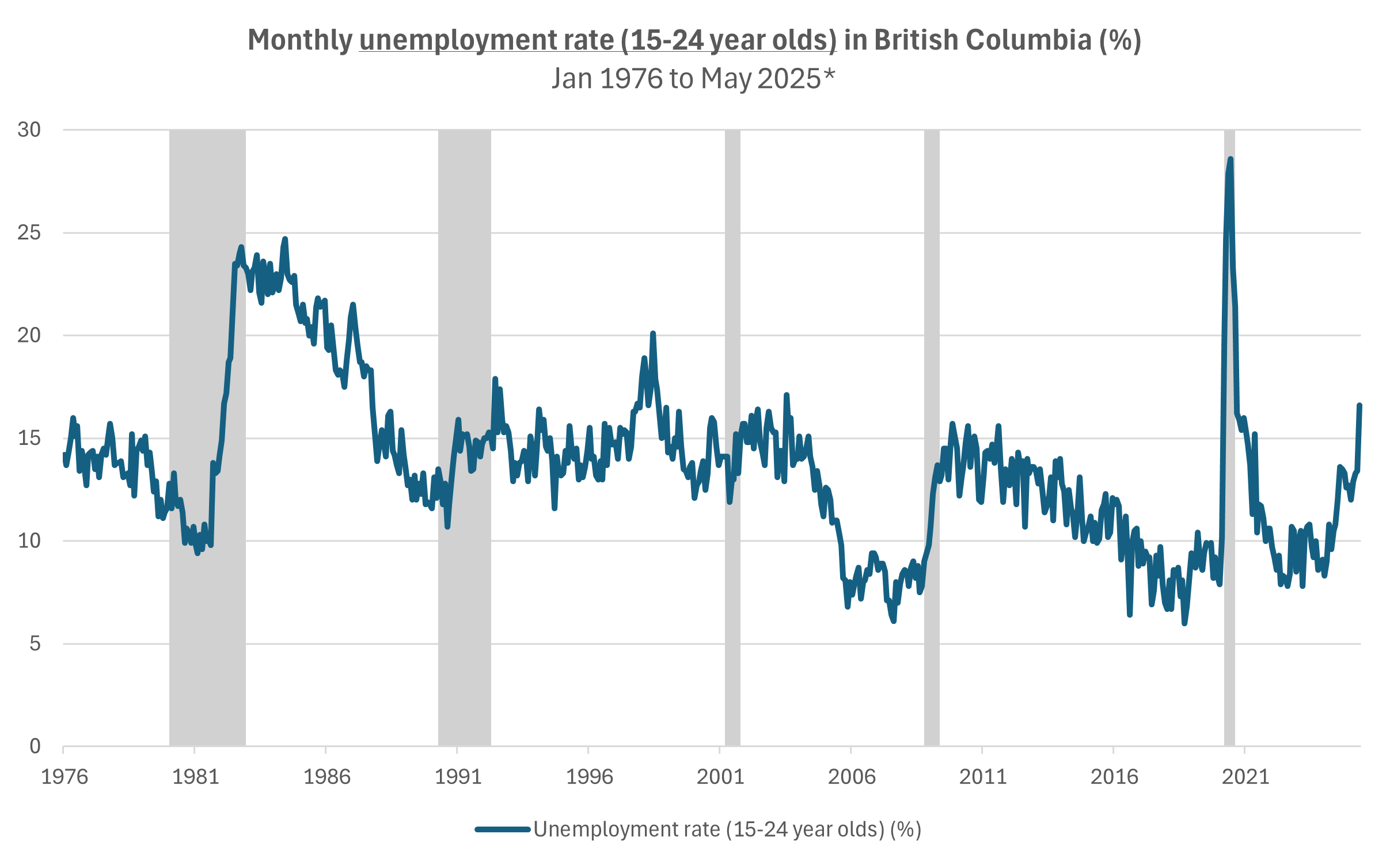
Moreover, this is the highest youth unemployment rate B.C. has seen since the depths of the COVID-19 recession in August 2020 (Figure 6). Excluding COVID-19, B.C. has not recorded a youth unemployment rate this high since July 2003.
Figure 6: B.C.’s youth unemployment rate is the highest since August 2020
Source: Statistics Canada. Table 14-10-0287-01 Labour force characteristics, monthly, seasonally adjusted.
*Shaded areas represent national recessions or economic slowdowns in Canada, including: the early 1980s (1981–1982), early 1990s (1990–1992), the global financial crisis (2008–2009), and the COVID-19 recession (2020). The 2001 slowdown is included due to its labour market impact, despite no formal recession in Canada. Historical recession periods based on: C.D. Howe Institute, Business Cycle Council Historical Recession Dates (2021).
Conclusion
Young workers appear to be bearing the brunt of B.C.’s private sector labour market slump. Once a province with the fastest-growing youth labour market, B.C. now sees shrinking youth employment. Moreover, the unemployment rate for this cohort has jumped more than six percentage points over the past year and is the second highest in the country. This should be a concern for policymakers in Victoria.